DevOps
DevOps is a transformative approach that bridges the gap between software development (Dev) and IT operations (Ops), aiming to shorten the development lifecycle and deliver high-quality software continuously. By integrating development and operations, DevOps practices enable teams to accelerate delivery through automation, collaboration, fast feedback, and iterative improvement.
What is DevOps?
DevOps is more than a methodology—it’s a cultural and operational philosophy that emphasizes collaboration, automation, and iterative improvement. It breaks down silos between development, operations, security, and other teams, enabling organizations to:
- Shorten development lifecycles
- Deliver features continuously
- Improve software quality
- Respond quickly to incidents
Key focus areas:
- People: fostering collaboration and accountability
- Processes: streamlining workflows and removing bottlenecks
- Technology: leveraging automation, monitoring, and cloud tools
History of DevOps
The concept of DevOps emerged as a solution to the long-standing divide between software development (Dev) and IT operations (Ops). Before the 2000s, these teams operated in silos: developers wrote code while operations handled deployment and infrastructure. This separation often caused delays, errors, and friction, with software “thrown over the wall” from development to operations, resulting in long release cycles and frequent production issues.
In the early 2000s, Agile methodologies began transforming software development by introducing iterative, incremental work cycles, faster feedback, and closer collaboration within development teams. While Agile improved the speed and quality of software development, it did not fully address the gap between development and operations, as deployments and infrastructure management remained largely manual and slow.
The term “DevOps” itself was popularized around 2009 by Patrick Debois, who organized the first DevOpsDays conference in Belgium. DevOps was recognized as a cultural movement emphasizing collaboration, shared responsibility, automation, and continuous delivery. Throughout the 2010s, DevOps gained widespread adoption, especially in cloud-first organizations. Configuration management tools like Puppet and Chef, containerization with Docker, orchestration using Kubernetes, and monitoring platforms such as Prometheus and ELK Stack became essential components of the DevOps ecosystem. Security also became an integral part of the pipeline, giving rise to DevSecOps.
Core Principles of DevOps
GitLab outlines several key principles that form the foundation of DevOps:
- Automation: Automating repetitive tasks such as testing, builds, and deployments reduces human error and accelerates the software delivery process.
- Collaboration and Communication: Fostering a culture of open communication and collaboration between development, operations, and other stakeholders ensures alignment and shared responsibility.
- Continuous Improvement: Regularly assessing and refining processes helps in identifying bottlenecks and optimizing workflows for better efficiency.
- Feedback Loops: Implementing short feedback cycles allows teams to quickly identify issues and make necessary adjustments, leading to improved software quality.
- Security Integration (DevSecOps): Incorporating security practices throughout the development lifecycle ensures that security is not an afterthought but an integral part of the process.
Benefits of Adopting DevOps
Implementing DevOps practices offers several advantages:
- Faster Time to Market: Automation and streamlined processes enable quicker delivery of features and updates.
- Improved Quality: Continuous testing and feedback lead to higher-quality software with fewer defects.
- Enhanced Collaboration: Breaking down silos fosters better communication and teamwork across departments.
- Increased Efficiency: Automation of manual tasks reduces overhead and allows teams to focus on value-added activities.
- Stronger Security: Integrating security throughout the development lifecycle ensures robust protection against vulnerabilities.
The DevOps Lifecycle and How DevOps Works
The DevOps lifecyle stretches from the beginning of software development through to delivery, maintenance, and security. The stages of the DevOps lifecycle are:
-
Plan: Organize the work that needs to be done, prioritize it, and track its completion.
-
Create: Write, design, develop and securely manage code and project data with your team.
-
Verify: Ensure that your code works correctly and adheres to your quality standards — ideally with automated testing.
-
Package: Package your applications and dependencies, manage containers, and build artifacts.
-
Secure: Check for vulnerabilities through static and dynamic tests, fuzz testing, and dependency scanning.
-
Release: Deploy the software to end users.
-
Configure: Manage and configure the infrastructure required to support your applications.
-
Monitor: Track performance metrics and errors to help reduce the severity and frequency of incidents.
-
Govern: Manage security vulnerabilities, policies, and compliance across your organization.
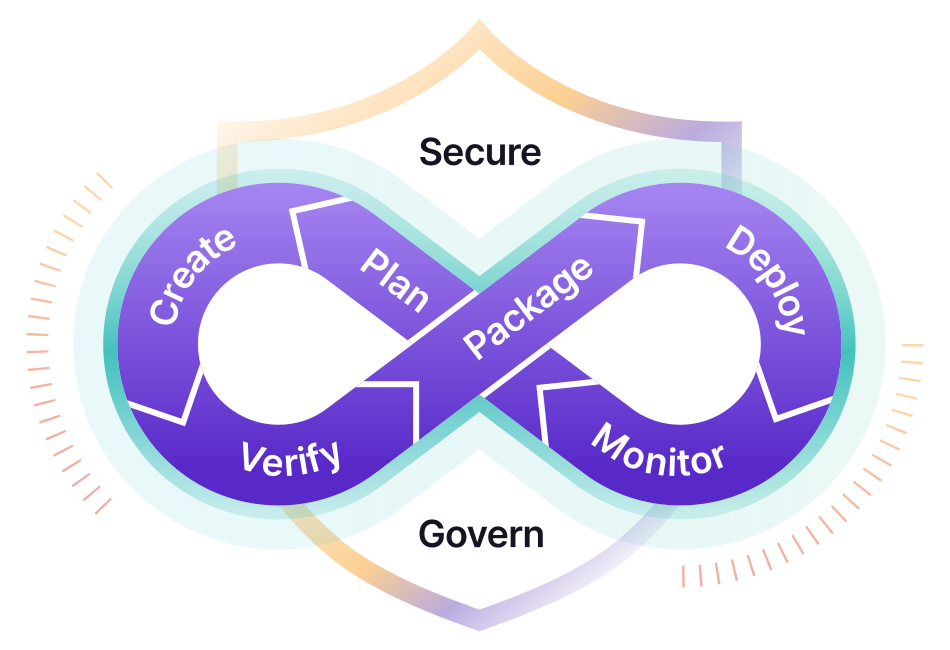
DevOps tools, concepts and fundamentals DevOps covers a wide range of practices across the application lifecycle. Teams often start with one or more of these practices in their journey to DevOps success.
DevOps Tools, Concepts and Fundamentals
DevOps covers a wide range of practices across the application lifecycle. Teams often start with one or more of these practices in their journey to DevOps success.
- Version control: The fundamental practice of tracking and managing every change made to source code and other files. Version control is closely related to source code management.
- Agile: Agile development means taking iterative, incremental, and lean approaches to streamline and accelerate the delivery of projects.
- Continuous Integration (CI): The practice of regularly integrating all code changes into the main branch, automatically testing each change, and automatically kicking off a build.
- Continuous Delivery (CD): Continuous delivery works in conjunction with continuous integration to automate the infrastructure provisioning and application release process. They are commonly referred to together as CI/CD.
- Shift left: A term for shifting security and testing much earlier in the development process. Doing this can help speed up development while simultaneously improving code quality.
- Infrastructure as Code (IaC): Managing and provisioning infrastructure through code instead of manual configuration. Tools like Terraform, Ansible, or CloudFormation enable consistent, repeatable deployments.
- Containerization: Packaging applications and dependencies into lightweight, portable containers using tools like Docker, which ensures consistency across development, testing, and production environments.
- Orchestration: Managing and scaling containers automatically using tools such as Kubernetes, which handles deployment, scaling, and operations of containerized applications.
- Monitoring and Observability: Continuously tracking system performance, logs, and metrics using tools like Prometheus, Grafana, or ELK stack, helping teams detect and resolve issues proactively.
- Security & Compliance Automation (DevSecOps): Integrating automated security checks and compliance audits into the pipeline using tools like Snyk, Aqua Security, or OWASP ZAP to ensure code is secure before release.
DevOps Metrics (Key Performance Indicators)
Tracking metrics is critical for measuring DevOps success. Important metrics include: Though there are numerous metrics used to measure DevOps performance, the following are four key metrics every DevOps team should measure.
1. Lead time for changes
One of the critical DevOps metrics to track is lead time for changes. Not to be confused with cycle time (discussed below), lead time for changes is the length of time between when a code change is committed to the trunk branch and when it is in a deployable state. For example, when code passes all necessary pre-release tests.
2. Change failure rate
The change failure rate is the percentage of code changes that require hot fixes or other remediation after production. This does not measure failures caught by testing and fixed before code is deployed.
3. Deployment frequency
Understanding the frequency of how often new code is deployed into production is critical to understanding DevOps success. Many practitioners use the term “delivery” to mean code changes that are released into a pre-production staging environment, and reserve “deployment” to refer to code changes that are released into production.
4. Mean time to recovery
Mean time to recovery (MTTR) measures how long it takes to recover from a partial service interruption or total failure. This is an important metric to track, regardless of whether the interruption is the result of a recent deployment or an isolated system failure.
CALMS Framework
CALMS is a framework that assesses a company's ability to adopt DevOps processes, as well as a way of measuring success during a DevOps transformation. The acronym was coined by Jez Humble, co-author of “The DevOps Handbook,” and stands for Culture, Automation, Lean, Measurement, and Sharing.
C – Culture
A – Automation
L – Lean
M – Measurement
S – Sharing
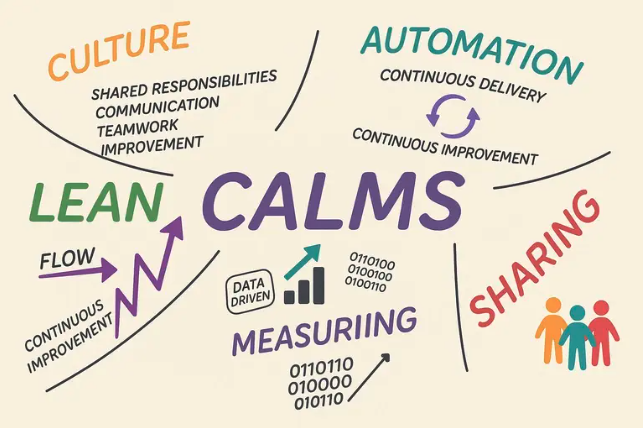
1. Culture
Culture is the foundation of DevOps and arguably the most important pillar. It focuses on creating an environment of trust, collaboration, and shared responsibility. In traditional organizations, development and operations teams often work in silos, leading to delays, miscommunication, and finger-pointing when problems occur. DevOps culture breaks down these barriers, fostering cross-functional teams where developers, operations, QA, and security professionals work together toward shared goals. Psychological safety is also critical: team members must feel comfortable admitting mistakes and raising issues without fear of blame. This culture ensures that teams are accountable not just for writing code, but for running and maintaining the software in production.
2. Automation
Automation is a core technical pillar of DevOps. It reduces repetitive, error-prone tasks and speeds up software delivery while maintaining consistency. Key areas of automation include builds, testing, deployments, and infrastructure provisioning (Infrastructure as Code). By automating these processes, teams can implement continuous integration (CI) and continuous delivery (CD), allowing code changes to be integrated, tested, and deployed rapidly. Automation also enables faster feedback loops, meaning issues are detected and fixed early, reducing downtime and improving overall system reliability. Examples include using Jenkins or GitLab CI/CD pipelines, automated unit and integration testing, and Terraform or Ansible for infrastructure management.
3. Lean
The Lean pillar focuses on delivering maximum value with minimal waste. Lean principles, inspired by manufacturing, emphasize optimizing workflows, eliminating bottlenecks, and iterating in small, incremental releases. In DevOps, this means prioritizing work that directly benefits users, continuously improving processes, and shortening the lead time from development to production. Lean practices encourage teams to adopt Agile methods such as Scrum or Kanban, enabling rapid iterations and frequent delivery of small, reliable features. This approach improves both efficiency and responsiveness to customer needs.
4. Measurement
Measurement is critical for making data-driven decisions and fostering continuous improvement. DevOps encourages tracking key performance indicators (KPIs) that reflect the health of both the software and the delivery process. Common metrics include deployment frequency, lead time for changes, change failure rate, and mean time to recovery (MTTR). Monitoring these metrics helps teams identify bottlenecks, evaluate the effectiveness of improvements, and ensure that software delivery aligns with business goals. Beyond metrics, measurement also includes monitoring system performance, user experience, and security posture to detect issues proactively.
5. Sharing
Sharing emphasizes knowledge transfer, transparency, and collaboration across teams. In DevOps, teams are encouraged to share insights from incidents, post-mortems, lessons learned, and best practices. Open communication ensures that failures become learning opportunities rather than sources of blame. Sharing also includes documentation, code reviews, and mentoring, which collectively build organizational knowledge and prevent repeated mistakes. By fostering a culture of collaboration, teams can continuously improve processes, enhance reliability, and accelerate innovation.
Summary
The CALMS framework provides a comprehensive approach to implementing DevOps by combining culture, technical practices, and process optimization. Focusing on Culture, Automation, Lean, Measurement, and Sharing allows organizations to break down silos, streamline workflows, accelerate delivery, enhance software quality, and cultivate a culture of continuous learning. By applying CALMS, teams can achieve the ultimate goal of DevOps: delivering high-quality, reliable software quickly and sustainably.