Information Security
In today's interconnected world, information security is no longer an optional add-on; it's the bedrock of trust and the foundation upon which reliable digital services are built. As developers, we are at the forefront of creating and maintaining these services, making our understanding and implementation of robust security practices paramount.
Why Information Security Matters
Think of the data our applications handle – personal information, financial details, critical operational data. A security breach can have devastating consequences, leading to:
- Financial Losses: Direct financial costs through fines, legal fees, and recovery efforts, as well as indirect losses due to reputational damage.
- Reputational Damage: Loss of user trust and confidence, making it difficult to attract and retain users.
- Legal and Regulatory Penalties: Non-compliance with data protection regulations can result in significant fines and legal action.
- Operational Disruption: Attacks can cripple services, leading to downtime and impacting business continuity.
Core Principles of Information Security
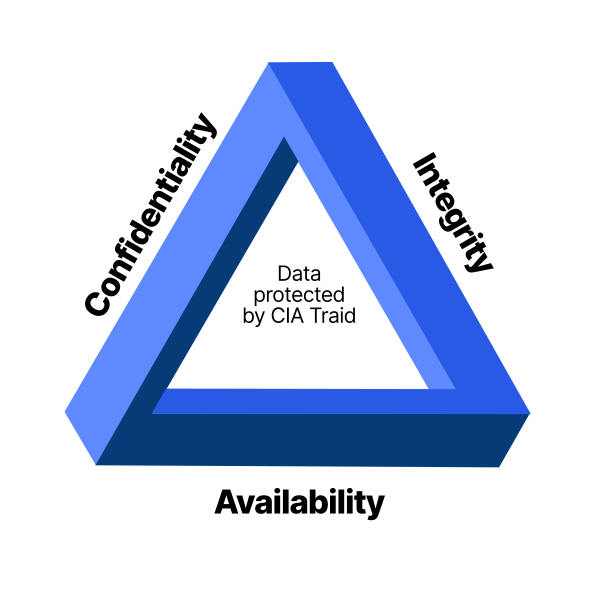
While the threat landscape is constantly evolving, several core principles remain fundamental to building secure systems. For developers building digital services, understanding the foundational principles of information security, the Confidentiality, Integrity, and Availability (CIA) Triad, is not just theoretical knowledge. It directly impacts the robustness, trustworthiness, and resilience of the applications you create. These three pillars serve as a constant guide in every design decision and line of code written. These are well-reflected in the guidance and resources provided by secure development platforms:
Confidentiality
Confidentiality ensures that sensitive information is strictly accessed only by individuals or systems explicitly authorized to view it. For developers, this means safeguarding data from unauthorized disclosure, whether it's user credentials, personal identifiable information (PII), or proprietary business logic.
Practical implementations include employing strong, industry-standard encryption for data both when it's stored on servers (data at rest) and when it's traveling across networks (data in transit via HTTPS, VPNs). Furthermore, developers must meticulously implement granular access control mechanisms (like Role-Based Access Control or Attribute-Based Access Control), ensuring that users only see the data relevant to their permissions, and utilize secure secrets management solutions to prevent sensitive keys or tokens from being exposed in codebases or configuration files.
Integrity
Integrity guarantees that data remains accurate, complete, and authentic throughout its entire lifecycle, preventing any unauthorized or accidental modification, alteration, or destruction. From a developer's perspective, maintaining integrity involves a disciplined approach to input and output.
This includes rigorous input validation to guard against common attacks like SQL injection and cross-site scripting (XSS) that aim to corrupt data or logic. Cryptographic tools like hashing (to detect tampering) and digital signatures (to verify authenticity and non-repudiation) are crucial for ensuring that data, once created or transmitted, has not been tampered with. Additionally, robust error handling, transactional consistency, and secure version control systems are essential to preserve the fidelity of the application's data and state.
Availability
Availability ensures that authorized users can consistently access services and information when needed, without undue delay or disruption. For developers, building for availability means designing systems that are resilient to failures, capable of handling expected loads, and resistant to malicious attacks.
This involves implementing architectural patterns such as redundancy and failover mechanisms (e.g., clustered servers, backup databases), employing load balancing to distribute traffic efficiently, and designing for scalability to accommodate fluctuating demand. Furthermore, developers play a key role in integrating robust monitoring, logging, and alerting systems to quickly detect and respond to any performance bottlenecks or denial-of-service (DoS/DDoS) attacks, ensuring a continuous and uninterrupted user experience.
Conclusion
Information security is an ongoing journey, not a destination. As developers, we have a crucial role to play in building secure and resilient digital services that protect user data and foster trust. By embracing the core principles of information security and adopting secure development practices and adapted to our local context, we can collectively build a more secure digital future.