Core Principles of Interoperability in Cambodia
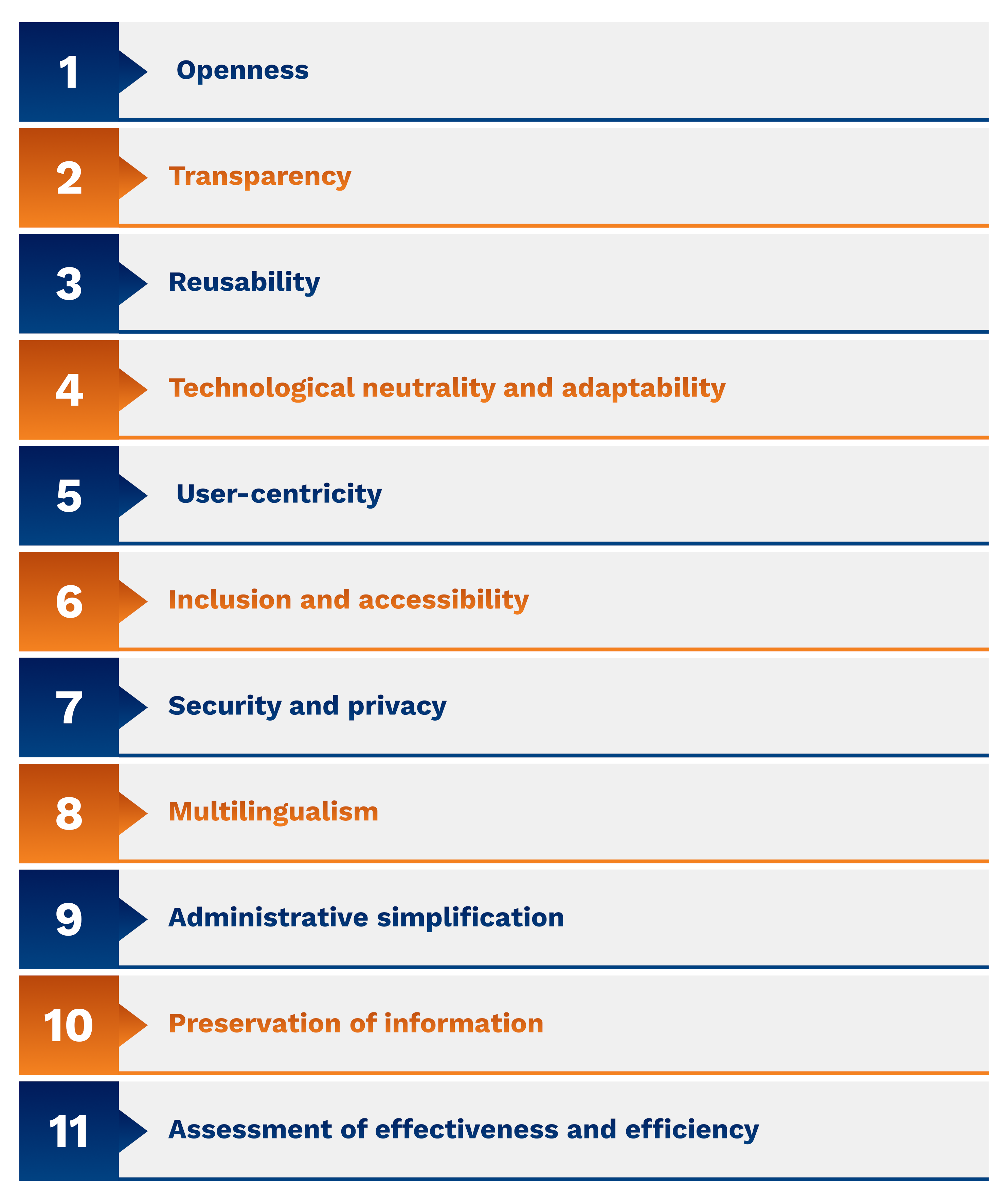
While enabling systems to interact is important, the design of these interactions should be guided by a set of fundamental principles. Adherence to these 9 principles, illustrated in Figure , will ensure that efforts to share data and open up systems improve the delivery of digital services and offer greater value to the people of Cambodia.
1. Openness
The principle of "openness" here primarily focuses on open data, open standards, and open-source software. For the openness of government data, Ministries and Public Agencies should make their public services available for discovery and use. This includes providing service catalogs, documentation, and digital public service offerings on their respective digital sites, while always protecting personal data, confidentiality, and intellectual property rights.
Regarding standards and software, when developing or procuring new systems, Ministries and Public Agencies should prefer the use of free and open-source software whenever applicable over proprietary, closed-source alternatives. If a suitable open-source solution does not exist, a closed-source product may be substituted, but it should come with appropriate protection mechanisms, such as a source code escrow. A list of commonly used open standards and open-source solutions can be found in **Appendix **
2. Transparency
Government digital services should be simplified whenever possible by removing unecessary steps and complexities in their delivery, regardless of whether these services are offered through a single ministry’s information system or an integrated one.
This commitment to transparency must also extend to the delivery process itself, ensuring that people requesting services have complete visibility into the status of their request. To that end, Ministries and Public Agencies must establish mechanisms for collecting and assessing feedback on the quality of each public service and make this information publicly available.
3. Reusability
The delivery of public services in an integrated environment often involves utilizing existing services and data from various government sources. This practice of reusability should be encouraged and made as straightforward as possible, without restricting access or hindering fair competition. This concept of reusability extends to all stakeholders, including the people and private sector partners who intend to access or consume these services and data.
In addition to reusing data and services, creating new government information systems should leverage existing solutions, either partially or entirely. This can involve using an agency’s own solutions or adopting those from other government entities. By doing so, agencies can conserve resources and time while providing more tailored and unified experiences.
4. Technology Adaptability
Since technology is bound to become obsolete and change over time, technical interoperability should be established using adapters. To the greatest extent possible, these adapters must be reconfigurable rather than replaceable to save time, cost, and complex- ity. While technological factors are key enablers for enhancing public service delivery, decisions regarding specific tools, frameworks, and languages should be made as late as possible, only after the communication channels and business problems have been clearly defined.
5. User-Centricity
Digital public services must be designed with consideration for the wide variety of users, many of whom may not be proficient in digital literacy. These services should also enable the "once-only" policy to avoid asking users to upload documents or provide information that is already held in government repositories. To be truly user-centric, people must be able to transact with the system through multiple channels, such as computers, phones, and even assisted methods like Interactive Voice Response (IVR) or SMS-based interac- tions. The user interfaces must be simple, consistent, and user-friendly across services from different departments, and it must be possible for people to access various services through a single window of access. Finally, help information related to navigation and steps to be taken must be clearly displayed while users are transacting with the system.
6. Inclusion and Accessibility
Inclusiveness refers to the ability to bring together diverse user groups within digital ser- vices, ensuring equal treatment regardless of individual backgrounds, ethnicities, beliefs, or social status. Accessibility, in this context, refers to the ease with which all people can engage with digital public services, whether they can do so independently or with assistance.
To create an inclusive and accessible digital public service, Ministries and Public Agencies should implement a multi-channel approach. This involves providing a variety of access points, including physical locations like post offices and community tech centers, as well as digital channels like telephone, email, and other electronic platforms. To ensure equal access, these services should be complemented by assistance programs specifically designed for individuals with special needs and the elderly. Furthermore, authorized third-party agents should be established to act on behalf of those who are temporarily or permanently unable to use the services directly. Digital public services must also be made available in open formats, allowing people to access them without incurring extra expenses for licenses or software. To support this, systems should enable people with disabilities to interact with government services through alternate modali- ties, such as voice commands or gestures.
7. Security and Privacy
Secure data exchange between Ministries, Public Agencies, and the people is crucial for effective public service delivery. This security should be implemented using established methods like public-private key exchange protocols, which utilize the digital signature of the entity. Furthermore, data-sharing agreements between the entities exchanging infor- mation must be formally established and be consistent with the scope of consent obtained from users. These measures are vital for ensuring the confidentiality and authenticity of exchanged data and services. User consent is required for data sharing and must be limited only to the extent specified by the user. Concerns about personal data protection are to be further supported by Cam- bodia’s Personal Data Protection laws and regulations where applicable. Consequently, the scope and rights for accessing a person’s private information must only be granted if explicitly authorized by that user’s consent.
8. Multilingualism
Preserving and promoting the Khmer language is crucial, as it represents Cambodian culture and heritage. Therefore, any government interface displaying information to the public must be, by default, in the Khmer language. To support all users, both Khmer and other language interfaces should be easily adaptable and supported by accessibility- focused translation services. This can be achieved by creating dedicated translation files to accommodate multilingual support.
9. Administration Simplification
Ministries and Public Agencies often collect extensive data as part of their initiatives or legal requirements. However, much of this information may already exist within another government entity. To streamline data management and reduce redundancy, government bodies should facilitate the reuse of existing data through secure sharing from other of- ficial data sources, in accordance with the "once-only" principle. This approach avoids direct access to other ministry’s databases, instead relying on secure, pre-agreed data exchanges. In addition, continuous business process re-engineering (BPR) is recommended to further improve and simplify governmental service delivery processes.